
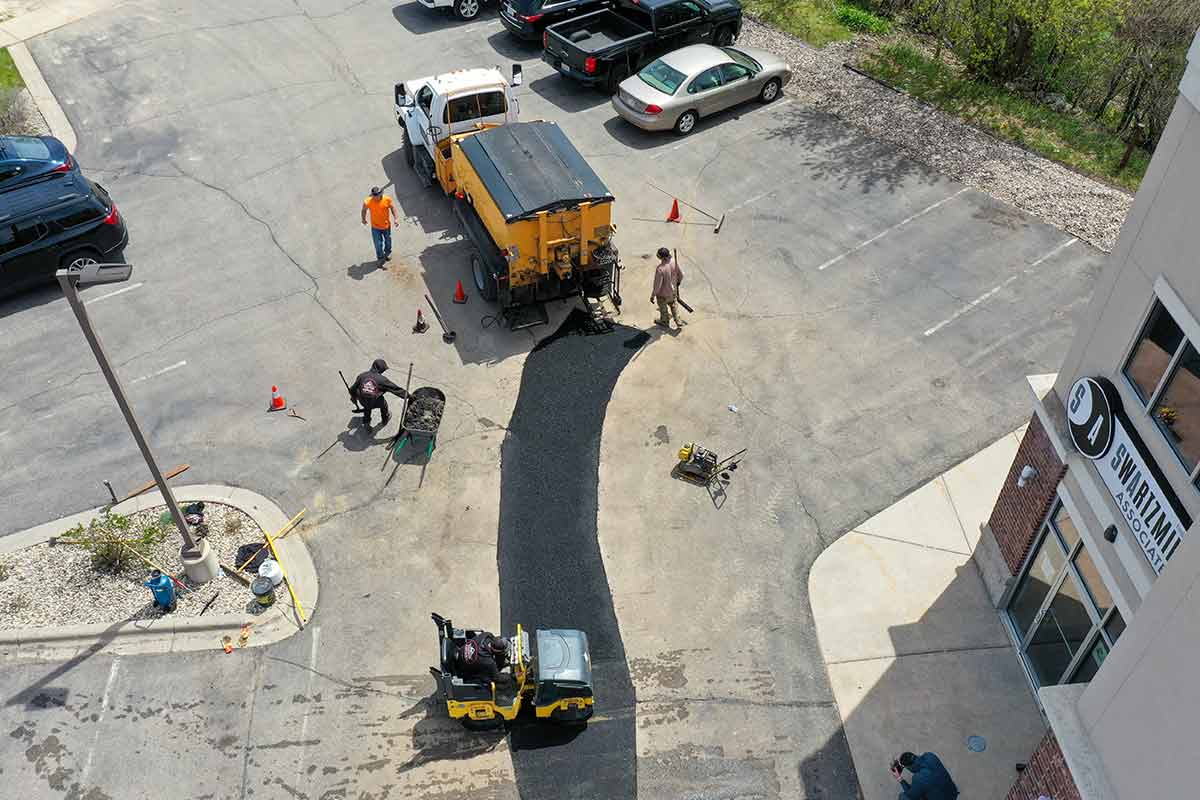
Crack Filling
The single highest-ROI maintenance service available. Stop water at the surface before it destroys the base.
04 / Service
← View all servicesCommercial Crack Filling & Asphalt Crack Sealing for Long-Term Pavement Health
Cracks are how water gets into the base. Water plus freeze-thaw cycles is what turns a $300 crack fill into a $30,000 reconstruction. Hot-pour rubberized crack sealing keeps moisture out, stays flexible through Wisconsin and Minnesota winters, and is the single best dollar-for-dollar spend on any commercial lot.
Our Process
Step-by-step,
self-performed.
- 01
Inspection
Walk the lot and flag active working cracks — sealcoat-only candidates vs. true crack-fill candidates.
- 02
Clean Out
Compressed air or heat lance to clear dirt, vegetation, and old failed sealant. Cracks must be clean and dry to bond.
- 03
Hot-Pour Application
Melted rubberized sealant applied at material-spec temperature directly into the crack, flush with the surface.
- 04
Cure & Reopen
Sand or detack as needed, then reopen to traffic — typically within hours, not days.
Materials & Equipment
What we run
- ASTM-spec hot-pour rubberized crack sealant
- Direct-fire crack-sealing melters
- Heat lances and compressed-air cleanout equipment
- Detack sand for fast reopen on summer pours
When It's Needed
Signs to look for
- Visible linear cracks wider than ~1/4 inch
- Cracks at construction joints, lot perimeter, or curb lines
- Lot is on a sealcoat cycle — crack-fill always runs first
- Pre-winter prep — closing cracks before freeze-thaw season
- Post-overlay year 2–3 when first surface cracks appear
Problems It Solves
What it fixes
- Water intrusion accelerating base failure
- Freeze-thaw expansion widening cracks every winter
- Vegetation root growth in unfilled cracks
- Small cracks turning into alligator cracking and full failure
FAQ
Straight answers.
How much does crack filling cost?
Priced per linear foot. On a typical commercial lot it's a small fraction of overlay or reconstruction — and it's the work that prevents both.
What size cracks should be filled?
Roughly 1/4" to 1" wide. Hairline cracks are best handled by sealcoat. Wider failures usually need patching or section replacement.
How long does crack sealant last?
3–5 years in our climate when applied to clean, dry cracks at correct material temperature. Cold-pour and poorly prepped applications fail within a year.
Get a Quote
Ready to scope
your crack filling project?
Property managers, GCs, and commercial owners — get a real, walked, written estimate from the crew that will actually do the work.